I Analyzed 60 Searches to find out
AI Overviews killed SEO. At least, that’s the narrative you hear everywhere at the moment. On the surface it does make sense. If Google can answer a search directly with an AI-generated summary, why would anyone need to click through to the traditional search results?
But there’s another question that gets less attention: Where does the AI Overview get its information from?
I wanted to find out if organic rankings affect AI Overviews citations. So I analyzed 60 Google searches, recorded 762 citation appearances, and compared the cited pages with their organic rankings.
What I found doesn’t suggest that SEO has become irrelevant. In fact, 63.5% of the citation appearances in my dataset came from pages ranking on Google’s first page.
But the interesting part is what happened beyond page one. Some sites ranking on page 2, 3, 4 and even outside the top 10 were cited repeatedly.
That led me to a different question:
Maybe AI search isn’t replacing SEO. Maybe it’s adding another layer to it?
The experiment
I selected 60 searches across topics including SEO, AI search, lead generation, landing pages, email marketing and kitchens.
For each query, I recorded:
- The sources cited in the AI Overview
- How many times each source appeared
- Whether the source was on page one, further down the SERPs, or outside the top 10
I also recorded the unusual cases, in which sites were either not ranking at all or were cited an unusual amount of times.
The question was simple: Does a page need to rank on Google’s first page to get cited by an AI Overview?
The results
The strongest pattern was immediately obvious.
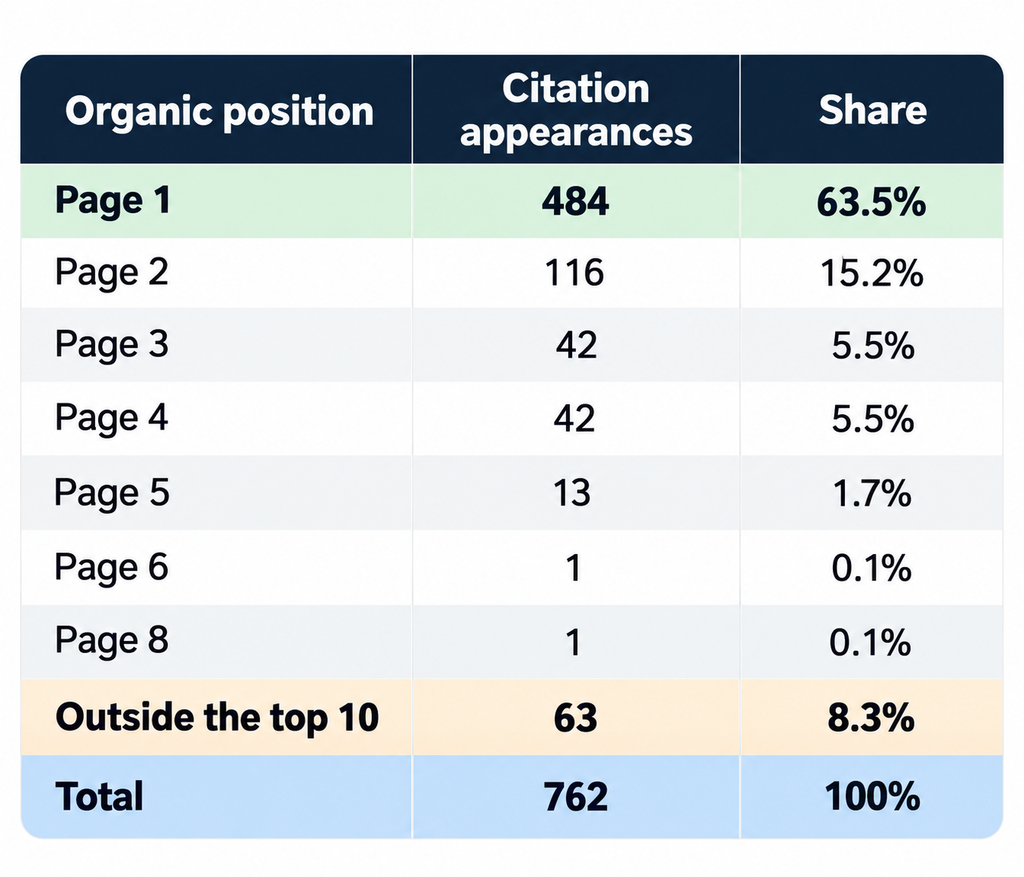
So yes, ranking on page one clearly matters. Nearly two-thirds of the citations I recorded came from pages ranking on the first page.
But that leaves 36.5% coming from page two or lower. And 8.3% came from sources outside of the top 10.
That makes it difficult to argue that AI Overviews simply take the traditional top 10 results and turn them into an AI answer.
There’s clearly more going on.
AI Overviews Didn’t Kill SEO. They are using it.
This is where I think the broader “SEO is dead” narrative gets interesting. My experiment doesn’t measure organic traffic or click-through rate, so it can’t tell us whether AI Overviews have reduced the number of clicks websites receive.
And there is evidence that they can. For example, a 2026 study of Google search behavior found that AI Overviews were associated with fewer clicks and that clicks directly to cited sources were rare.
So I’m not arguing that AI Overviews have had no impact on SEO traffic.
I’m arguing something narrower:
Traditional SEO still appears to matter to the information Google uses to construct AI answers.
That’s important. Because if SEO had truly become irrelevant, we’d expect little relationship between organic visibility and AI citations. Instead, in my dataset, page-one results were by far the largest individual group of cited pages.
And other studies are finding a similar relationship, although the exact numbers vary significantly depending on methodology and timeframe. For example, an Originality.AI analysis found 52% of organic AI citations came from top 10 results, while a later Ahrefs analysis reported a much lower 38% overlap, so the exact percentage is still up for debate.
But the bigger point remains: Organic rankings and AI citations are related, they just aren’t the same thing.
The surprising part: lower-ranking pages were sometimes cited repeatedly
This is where the data gets much more interesting. If ranking was the only thing that mattered, you’d expect the highest-ranking pages to dominate the citations. But I found several examples where pages ranking considerably lower were cited multiple times.
For example:
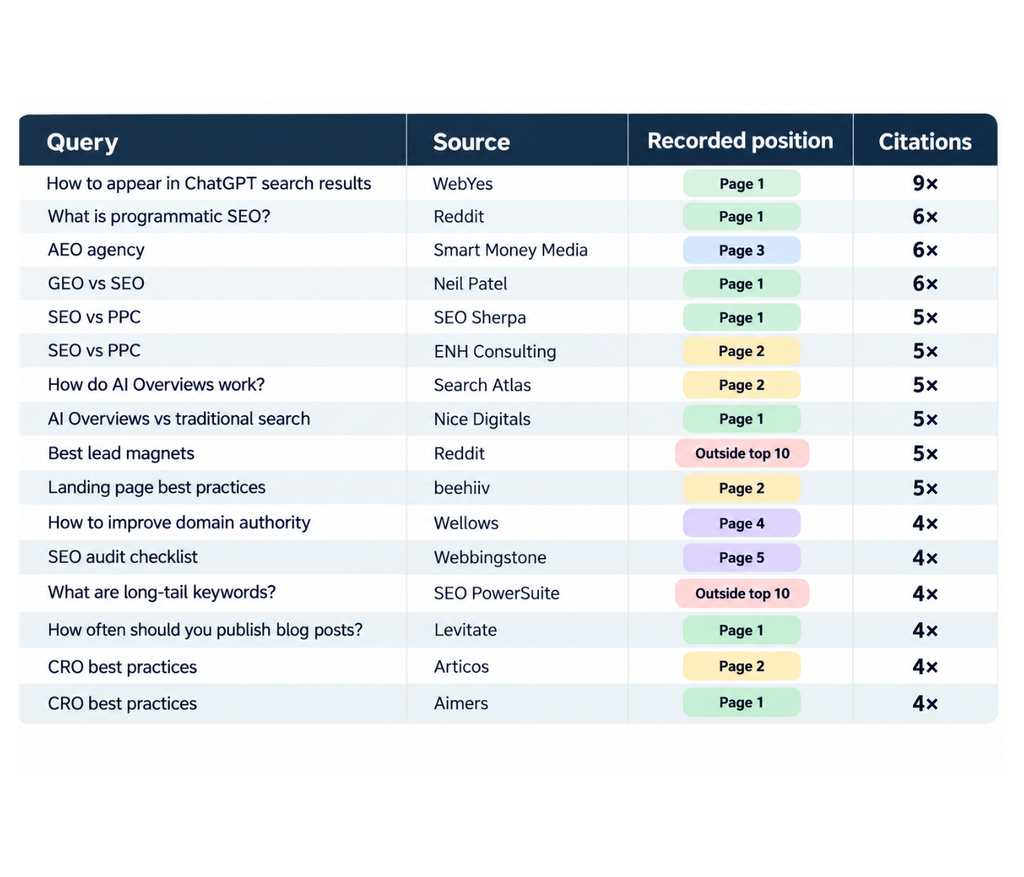
In this example, Wellows was recorded on page 4 but appeared four times for “how to improve domain authority.” Webbingstone was recorded on page 5 but appeared four times for “SEO audit checklist.” And a Reddit result recorded outside the top 10 appeared five times for “best lead magnets.”
This means that there is now an opening for pages not ranking on Google to start getting shown on the first page. That raises a more interesting question: What makes a page useful enough for an AI Overview to keep citing it?
What do highly cited pages have in common?
Looking at the repeatedly cited pages, I noticed several patterns.
1. Extremely strong query-to-page alignment
The page is usually about exactly what the person searched for. Not vaguely related. Not a huge general guide where the topic happens to be mentioned. The page often targets the specific question or concept directly.
For example:
- “How to improve domain authority”
- “How to appear in ChatGPT search results”
- “What are long-tail keywords?”
- “SEO audit checklist”
The closer the contents of the page are to the query, the easier it is for an AI system to determine that the page contains relevant information.
2. The content is easy to extract
Many of these pages are structured with:
- Clear headings
- Short sections
- Lists
- Tables
- Definitions
- Examples
- Step-by-step instructions
- FAQs
That’s useful for humans. But it’s also useful for AI systems that need to extract a specific piece of information and incorporate it into an answer.
3. The page contains multiple useful answers
This might be the most interesting pattern. Imagine an article about an SEO audit.
It could explain:
- What an SEO audit is
- Why you need one
- What to check
- Technical SEO issues
- On-page issues
- Backlinks
- Content
- Tools
- A complete checklist
That’s a lot of separate questions that the same page can potentially answer. And that could explain why one URL sometimes appears in an AI Overview four, five or six times.
4. Specific information beats generic statements
The highly cited pages also tend to contain things an AI can actually use:
- Statistics
- Examples
- Research
- Specific recommendations
- Comparisons
- Definitions
- Concrete processes
“SEO is important for businesses” isn’t particularly useful but “Here are the five things you should check when auditing a site” is something it can use in its answer.
So does SEO still matter?
Based on this experiment, yes but probably not in exactly the same way it used to. Traditional SEO gets your content into Google’s search ecosystem. And ranking well still appears to give you a significant advantage when it comes to AI citations.
But ranking isn’t the entire story. A page can rank highly and never become an important source in an AI answer. And a page ranking much lower can sometimes become a surprisingly important source.
That suggests a two-part model:
Traditional SEO
Can Google find and rank your content?
AI search optimization
Can an AI system understand, extract and use your content?
The future of search seems to require both.
The takeaway
After 60 searches and 762 citation appearances, I don’t think the data supports the idea that AI Overviews have simply made traditional SEO obsolete. Quite the opposite.
63.5% of the citation appearances in my dataset came from first-page results. But first-page rankings weren’t a requirement. More than a third of the citations came from page two or lower, and some pages ranking on page 4, page 5, or outside the top 10 were cited repeatedly.
So ask yourself whether your content is useful enough to actually be used or just a way for you to rank on Google?
Want to see the raw data?
I’ve made the complete research dataset available here, including all 60 searches, cited sources, citation counts, and recorded organic positions.