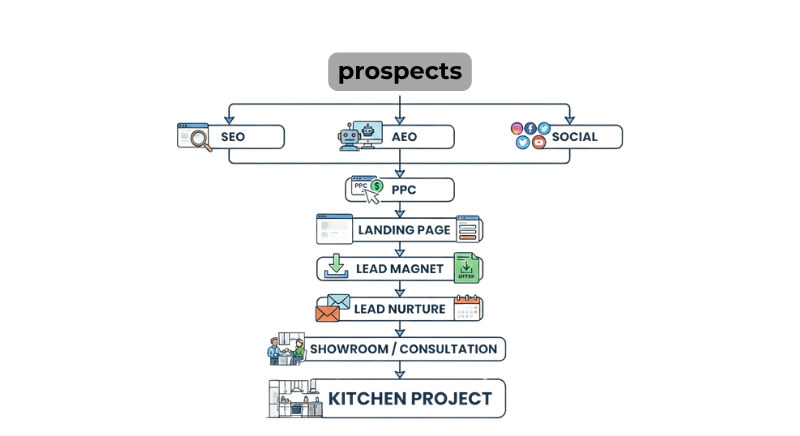
A good kitchen marketing strategy in 2026 consists of SEO (search engine optimization), AEO (answer engine optimization), social media content, PPC (pay per click advertisements), kitchen showroom marketing and lead nurture. Having a kitchen marketing system like this gets you consistent leads (people looking to buy or remodel their kitchen).
In 2026 you can’t rely on just one of these channels as they all work together in unison. SEO and AEO help you reach people searching for kitchens organically in Google searches and people asking their favorite AI chatbots about kitchens. Social media content helps you reach a cold audience, build up trust and grow an audience. PPC for kitchen companies helps to reach both people actively looking to buy a new kitchen and also people who are thinking about it. Kitchen showroom marketing helps to get people to your showroom so you can sell to them face to face. Lastly, having a lead nurture system is super important as a kitchen company, because customers are not going to buy on the first interaction with your company.
Each of these ideas will help you on their own but if they are combined into a system, it will generate leads for you 24/7. This article is the complete guide on how to set it up for your kitchen business so you can start getting leads even while you sleep.
Marketing for Kitchen Companies
Marketing for kitchen companies can be divided into four main pillars: paid advertising, search engine optimization (SEO) and answer engine optimization (AEO), organic content, and referrals.
Paid advertising can include both online and offline channels, but digital marketing for kitchen companies has become increasingly important as customers research kitchens, compare businesses, and look for inspiration online before making a purchase.
SEO and AEO can help kitchen companies get discovered when potential customers are searching Google or asking AI tools for advice, recommendations, and information about kitchens.
Organic content can be a cost-effective way to reach potential customers and build trust, although it can be difficult to predict which videos, posts, or other content will gain traction.
Referrals can also be an important source of new business, particularly for kitchen companies where trust and previous work play a major role in the buying decision. However, referrals can be difficult to predict and scale consistently.
The challenge is turning these different marketing channels into a reliable system for generating qualified kitchen leads. That’s where digital marketing agencies for kitchen companies can help. A specialist agency can build and manage the digital marketing system from attracting potential customers to capturing, qualifying, and nurturing leads, while the kitchen company focuses on designing, manufacturing, and installing kitchens.
How a kitchen marketing strategy works
The goal of kitchen marketing isn’t simply to get more people to visit your website or follow you on social media. The goal is to consistently move potential customers from discovering your business to becoming a kitchen customer. A simple kitchen marketing system has four stages:
1. Attract
Use SEO & AEO, social media, Google Ads and Meta Ads to get your kitchen business in front of potential customers.
2. Capture
Give interested prospects a reason to take the next step, such as downloading a kitchen planning guide, requesting a catalogue, booking a consultation or visiting your showroom.
3. Nurture
Most people aren’t ready to buy a kitchen the first time they discover your business. Use email to send out useful content, project examples and testimonials to stay in front of them while they make their decision.
4. Convert
Once they’re ready to move forward, make it easy for them to book a consultation, visit your showroom, request a quote or start their kitchen project.
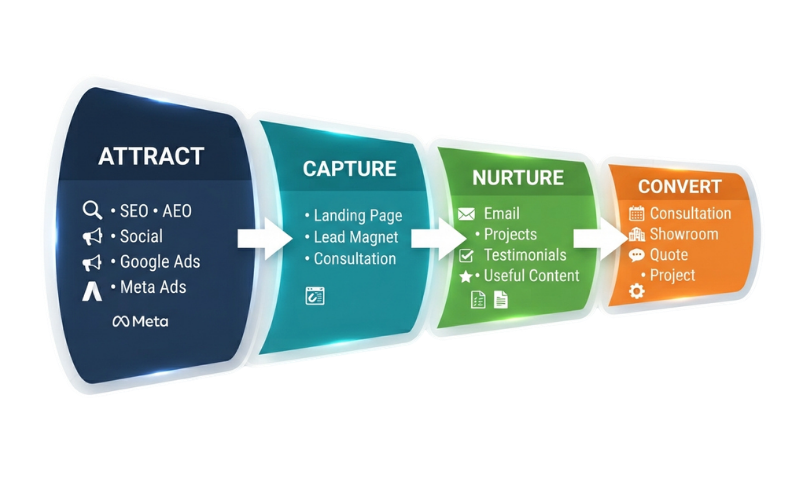
The rest of this guide explains each part of this system and how to use it to market a kitchen business.
SEO for marketing kitchens
SEO or search engine optimization works to get you ranked on Google and other search engines. As a local business it is vital to show up on the first page of searches in your area. People searching for a kitchen naturally click on the first results that are shown to them. To get ranked you need to optimize two things. Your website and your Google business profile.
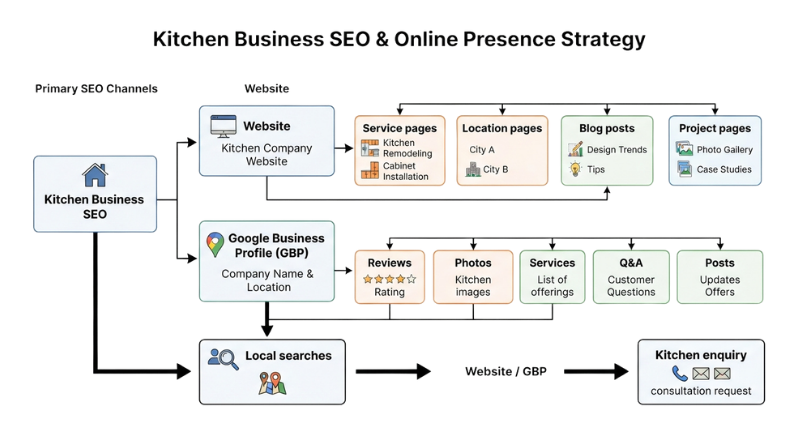
Optimizing your kitchen companies website for SEO
Optimizing your website means having lots of useful articles and pages filled with information about who you are and what you do. The BIGGEST mistake I see kitchen companies make regarding SEO is that they only have pictures on their websites. Yes, having pretty before and after pictures and lots of images of completed jobs is necessary for people to make a decision. BUT if you have no texts that Google can read on your site, they won’t know you exist. Images do have a place and that’s the “our work” or “gallery” part of your site. However if your whole site consists of mostly images, then you just won’t rank. So what should you write about?
The best kitchen marketing strategy SEO part consists of blog posts and informational pages. In your blogs you should write about useful information that people are searching for online. For example “bespoke kitchen design”, “bespoke kitchen cabinets” or “modular kitchen design L-shape” that way when people are looking for those terms on Google, there is a high chance that your website will show up.
In the informational pages like “our services” and “about us” you should write about who you are, what you do and who you serve. This is REALLY important for showing up in local rankings. For example, if someone Googles “bespoke kitchen manchester” you want to be the first kitchen company that shows up. Otherwise there is a high likelihood of them buying from your competitors. So add sentences like “We are a bespoke kitchen manufacturer in Manchester” and “We make premium bespoke kitchens in Manchester”, that way you have a higher chance of showing up when people search for businesses like yours.
Google business profile for marketing kitchens
For a business like yours, especially one focused on high-quality craft and cabinetry a Google Business Profile (GBP) is effectively your digital storefront. Since your clients are likely looking for local expertise, having a strong presence on Google Maps and Search is one of the most effective ways to capture high-intent leads.
Why do you need a Google business profile as a kitchen company?
- Visibility & Local SEO: When someone searches for “kitchen renovation” or “custom furniture” in your area, your profile helps you appear in the “Local Pack” (the map-based results at the top of the page).
- Trust and Credibility: Your profile acts as a digital portfolio. Potential clients check reviews, photos, and business details before reaching out. A complete, verified profile signals professionalism.
- Action-Oriented: It turns searchers into leads. With direct buttons for “Call,” “Directions,” and “Website,” you remove friction from the customer journey.
- Data-Driven Insights: You gain access to analytics showing how many people found you, what they searched for to get there, and whether they clicked your website or asked for directions.
- Cost-Effective Marketing: It is a free tool that significantly boosts your organic reach, allowing you to compete with competitors by showing up for relevant local queries.
How to optimize your Google business profile?
- Setup
- Verification: Ensure your business is fully verified. Without this, you cannot control your information or respond to reviews.
- NAP Consistency: Your Name, Address, and Phone number must be identical across your Google profile, your website, and any other directories (like Facebook or local business lists).
- Categories: Choose primary and secondary categories that specifically match your services (e.g., “Kitchen Remodeler,” “Cabinet Maker”).
- Visuals
- Portfolio Photos: Upload professional photos of completed kitchens, detailed shots of woodworking, and finished installations.
- Behind-the-Scenes: Add photos of your workshop or your team at work to humanize your brand and build trust.
- Fresh Content: Treat your photos like a social media feed. Update them regularly to show new projects.
- Proactive management
- Review Management: This is critical. Ask happy clients for Google reviews. Always respond to them, thank the positive ones, and professionally address any negative ones. Incorporating relevant keywords like “custom kitchen installation” into your responses can also boost your local SEO.
- Google Posts: Use the “Updates” or “Posts” feature to share current projects, seasonal offers, or industry tips. This keeps your profile active in Google’s eyes.
- Q&A Section: Don’t wait for customers to ask questions. Pre-populate your Q&A section with FAQs like “Do you provide custom cabinet measurements?” or “What areas do you serve?”.
- Products and services
- Service Listings: Treat your services like “Kitchen Cabinet Installation” or “Bespoke Woodwork Design” as individual items. Give each one a detailed description that includes the keywords your customers are searching for.
- Call to Action: Use the built-in features to make it easy for people to book a consultation or visit your website.
AEO for kitchen marketing 2026
Now AEO or answer engine optimization is quite a new way to market kitchens. This kitchen marketing strategy aims to have your kitchen company show up when people are asking their favorite AI questions about kitchens. Sometimes it also helps you show up at the top of Google searches as they now have their AI Overview on almost all pages. To get cited in AI searches you need to have articles that are useful and easy to read. Being on the first page of Google also helps.
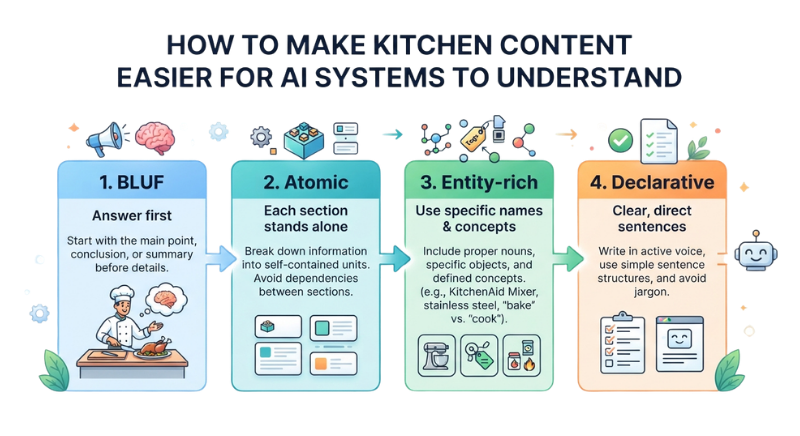
4 principles that help to promote kitchen businesses in AI searches
There are 4 strategies you NEED to follow to get your content cited by AI searches. They are BLUF (bottom line up front), atomic content, entirety-rich writing and simple & declarative. By writing all your content this way it will make it much easier for people and AI-s to read the information you are trying to convey.
- BLUF or bottom line up front means writing the main point or answer as the first paragraph in your articles sections. This will help your readers and AI searches find the answer more quickly. By structuring your articles in this manner you have a MUCH higher chance of getting cited.
- Atomic content means that every section of your articles needs to make sense on their own. It is harder for AI-s to find answers quickly from your site, if they can’t skim your content. For example if you write about bespoke kitchen doors and in the section about materials you only give partial information about design features because you already talked about it in the last section, then AI-s can’t get the full answer from your site and they won’t cite it.
- Entity-rich writing means that you need to use a lot of entities (people, places, places, brands..) in your sentences. For example: Google helps users find what they are searching for online faster than anyone else. Instead of: This tool helps you search topics online. You should try to be as specific as possible.
- And lastly your texts should be simple and declarative. Use simple and easy to use sentences. This will help your readers and AI searches to understand what you are saying much faster. Which will make it more likely that you will get cited in AI searches.
Voice assistant optimization
Voice assistants like Siri, Google Assistant, Alexa, and in-car infotainment systems have fundamentally changed how people search. Instead of typing short, fragmented keywords into a search bar (e.g., “kitchen remodel cost”), people speak to their devices in full, conversational sentences. When it comes to high-ticket industries like custom kitchens, voice search and AEO (Answer Engine Optimization) dictate how a brand gets recommended.
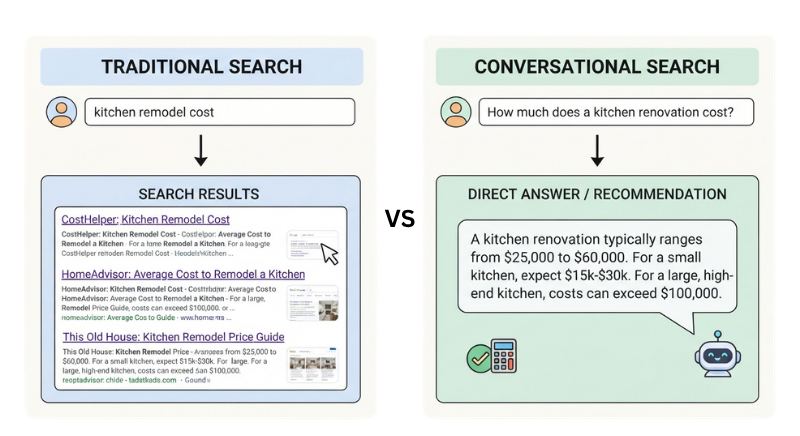
How Voice Search Behavior Differs
- Conversational Phrasing: A user talking to their phone or a smart speaker will ask a complete question, such as: “Siri, who is the best custom kitchen designer near me?” or “Alexa, how much does a kitchen renovation typically cost?”
- Zero-Click & Single-Answer Outcomes: When someone uses a voice assistant, they usually don’t get a list of ten blue links. The device reads out one single answer (or names one or two top local businesses). If you are not the one cited, you lose the lead entirely.
- High Local Intent: A massive percentage of voice searches carry immediate local intent (“near me,” “open now,” or looking for a showroom to visit today).
How to Optimize for Voice Assistants in Your Article
- Target Natural Language & Long-Tail Questions
Move away from rigid keyword fragments. Content needs to address exact homeowner pain points phrased as questions.- Bad: “Custom kitchen designer London”
- Good Voice Target: “How long does it take to design and install a custom kitchen?”
- Deploy FAQ Schema Markup & Concise Formatting
Voice assistants and AI answer engines love structured data. Brands should include dedicated FAQ sections on their website pages using FAQ Schema code. The answers should be direct, ideally 1 to 3 punchy sentences right under a question-based heading. Making it easy for an AI or voice algorithm to lift and read aloud. - Feed the Ecosystem (Reviews & Citations)
Voice assistants don’t just scrape a website; they cross-reference authority. When a user asks for a recommendation, algorithms look at real-time signals: Do they have a high volume of recent Google reviews mentioning specific terms like “kitchen installation” or “cabinet craftsmanship”? Are they consistently cited across local business directories and regional platforms?
Using social media to market your kitchen business
Social media is a great way to reach people who have never heard of your brand and build up trust with them. Unfortunately most companies only publish photos of their completed kitchen projects and that’s why they never reach new audiences. In 2026 videos are the best way to market your kitchen business on social media. There is one caveat to this, you should NEVER try to sell anything on social media directly. Otherwise you will kill your reach because people hate looking at ads. There is still a way to get people to turn into customers from your social media content. For that you need to create two types of content. Wide, which will go viral and reach a lot of people and deep, which will be more product and service focused. That way you will reach a big audience and you can convert the people who are looking to buy a new kitchen, without selling to them.
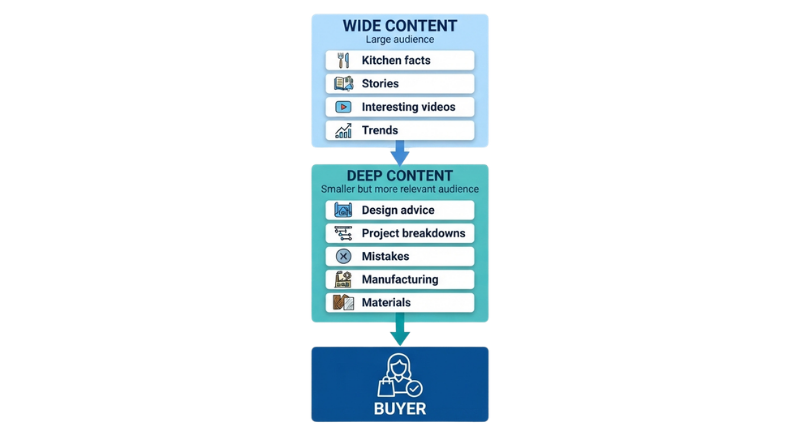
Wide content: viral marketing strategy for kitchen builders
Wide content is like casting a net to catch fish. Yes, you will get viewers who aren’t interested in buying a kitchen. But you will also get a LOT MORE viewers who are interested in buying a kitchen than you would have gotten by only creating deep content.
To create wide content I recommend sharing interesting facts about the history, customs and stories about kitchens. Just think about the unusual things you know about your industry that people might find interesting. Then share them through stories you can tell on camera.
Deep content: turn your audience into buyers
As always there is 3% of the marketplace that is actively looking to buy your products and services. To convert them into buyers you need to create deep content. This is the content in which you show how you produce your kitchens, share what people should think about before ordering a kitchen, list out 3 of the most common design mistakes you see most often, etc.
By posting content like this you will position yourself as an expert and the people in your audience who have gotten useful information from you will naturally turn into buyers. That’s why you should have a link to your website or even a dedicated landing page in your social media bios.
PPC for kitchen marketing
PPC or pay per click advertising is the easiest way to reach people who are actively looking to buy, who are thinking of buying and those that are open to buying. Google search ads are the easiest way to target the people who are actively looking to buy but they are also more expensive. With Meta ads you can reach more people and your cost per click will be lower, however your conversions will also be lower. To get the most out of Meta ads we run a 4 part system, that consists of the ads, a dedicated landing page, an offer and a lead nurture sequence.
Using Google ads to promote your kitchen business
Running a profitable Google Ads campaign for a high-ticket business like a kitchen design and manufacturing company comes down to one core rule: protect your budget from low-intent “window shoppers” and laser-target homeowners who are ready to invest.
Because kitchen remodels involve large budgets and long consideration cycles, a generic spray and pray approach will burn through cash quickly. The best strategy centers on high-intent capture, hyper-local precision, and aggressive exclusion.
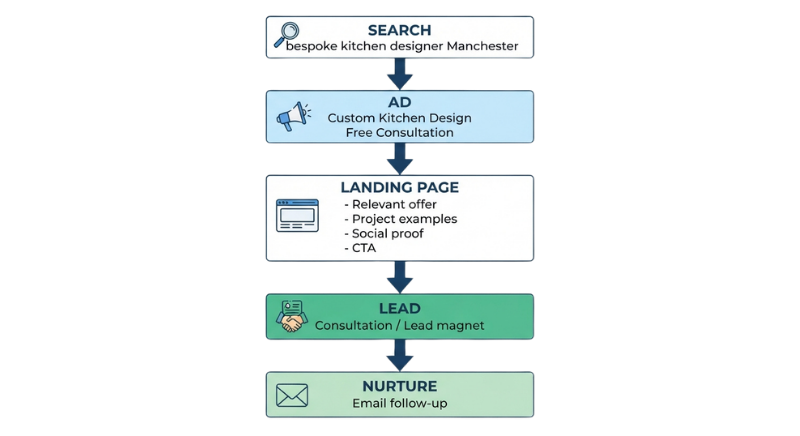
- Only target High-Intent Searches
Skip broad Display or YouTube campaigns. For high-ticket services, Google Search Ads are where the money is made because they capture people actively typing their needs into the search bar.
- Service-Specific Ad Groups: Separate your campaigns into tight, siloed ad groups like custom kitchen cabinets, full kitchen remodeling and bespoke kitchen doors. Do not lump everything into one generic “kitchens” group.
- Targeting “Buyer Intent” Keywords: Focus heavily on phrases that signal someone is looking to buy, not just research.
- Good: “Custom kitchen designer near me,” “Kitchen cabinet maker (your city),” “High-end kitchen remodeling contractors.”
- Bad (Avoid): “Kitchen design ideas,” “DIY kitchen paint,” “How to install a backsplash”.
- Use a Negative Keyword List
This is where most campaigns fail. You must actively starve irrelevant searches of your ad spend from day one.
- Exclude DIY & Informational: Add negative keywords like DIY, how-to, ideas, plans, design inspiration, cheap, low cost, IKEA, hardware, replacement parts.
- Weekly Search Term Audits: Review your actual search terms report at least weekly. If Google shows your ad for something irrelevant, add it to your negative keyword list immediately to refine your traffic.
- Hyper-Local Geographic Targeting
Kitchen manufacturing and installation are bound by logistics and service radiuses.
- Lock Down Your Geo-Settings: Set your location targeting strictly to your service area like specific cities, zip codes, or a tight radius around your showroom/workshop.
- Use “Presence” Settings: Ensure Google is set to target people “Presence: People in or regularly in your targeted locations,” rather than the default setting which also includes people merely interested in the area. This prevents international or out-of-market clicks.
- High-Converting, Pre-Qualifying Ad Copy
Your ad text needs to attract the right homeowner while gently deterring low-budget tire-kickers.
- Lead with Value & Trust: Highlight what matters to high value clients: craftsmanship, guarantees, custom 3D design, or local manufacturing.
- Headline Idea: Custom Kitchen Design | Free On-Site Consultation | (Company Name)
- Pre-Qualify via Copy: Mentioning things like “Bespoke Craftsmanship,” “Turnkey Installation,” or focusing on quality implicitly signals to budget-seekers that you operate in a higher tier, saving you wasted clicks.
- Maximize Extensions: Use Call extensions (so mobile users can tap to call instantly), Location extensions, and Sitelinks pointing directly to your portfolio or specific project galleries.
- Dedicated, Frictionless Landing Pages
Never send Google Ads traffic to your homepage. Every click should land on a dedicated, highly relevant landing page built for that specific ad group.
- Message Match: If the user clicked an ad for Custom Kitchen Cabinets, the headline of the landing page must immediately echo that exact phrase.
- Show, Don’t Just Tell: Feature high-resolution photography of your actual workshop and past installations front and center. For a visual product like custom cabinetry, imagery does the heavy lifting.
- Offer a lead magnet: To increase your conversion rates, you should implement a lead magnet. This can be a guide or a video tutorial or a checklist, that people get in exchange for their contact details.
- Frictionless Conversion: Keep forms short and direct. Offer a clear, low-friction Call to Action (CTA) like “Book a Free Design Consultation” or “Request a Quote” or “Get your checklist”.
How to promote your kitchen business on social media?
To promote your kitchen business on social media we use our four part system Our Meta ads system for kitchen companies consists of the ads, a dedicated landing page, a high value content offer and a lead nurture sequence. We do this because most people are not ready to buy a kitchen the first time they see your brand. So we just try to get their contact details, that way you can stay in touch with them until they are ready to buy. By structuring your ads this way, you can convert a lot more people from Meta ads.
- Meta ads for kitchen builders
The MOST important rule for social media marketing is that the ads NEED to look like organic content. People hate looking at ads so they will scroll past them if they look like ads. You also need to write great copy and scroll stopping headlines, otherwise most people will not click on your ads.
- Creating a dedicated landing page to send your visitors to
One of the BIGGEST mistakes I see kitchen companies make is that they send their traffic (visitors) to their home page. This will confuse the people who clicked on your ad for a specific reason and they will leave. The landing page you send people to should have a similar headline to the one you used in the or even the same one. This will ensure the visitor that they got to the right place.
- Making a high value content offer for a kitchen business
This is one of the trickiest parts. You want to create something that is so valuable that you would happily charge money for it. And then you want to give it away for free, in exchange for your prospects’ contact details. The higher the perceived value, the higher your conversion rates will be. A well-targeted lead magnet can significantly increase the percentage of visitors who give you their contact details, although conversion rates vary widely depending on the offer, traffic source and audience.
- Lead nurture sequence
Because the buying process for a kitchen is so long you NEED to keep in contact with your prospects. The easiest way to do this is to set up an automated lead nurture sequence.
Landing Pages for Kitchen Businesses
A landing page is a dedicated page designed to turn visitors into leads or customers. Unlike a normal website page, it has one primary goal and removes anything that could distract the visitor from taking the desired next step.
Your landing page should always match the reason the visitor arrived there. For example, if someone clicks an ad about kitchen remodeling for a home renovation, the landing page should immediately explain how your business can help with that type of project. The headline, offer, images and call to action should all reinforce the same message.
This is called message match, and it is one of the most important principles of landing page design. If someone clicks an ad promising a kitchen design consultation and lands on a generic homepage, they may not immediately understand that they are in the right place.
You should also A/B test your landing pages to find out what converts your visitors best. I usually like to test a short version against a longer version.
The short version might contain:
- A clear headline
- A subheading explaining the offer
- Social proof, such as testimonials or reviews
- A simple contact form or call to action
The longer version can include everything above, plus:
- More information about the offer
- Features and benefits
- Examples of completed projects
- More social proof
- Answers to common questions
- Another form or call to action at the bottom of the page
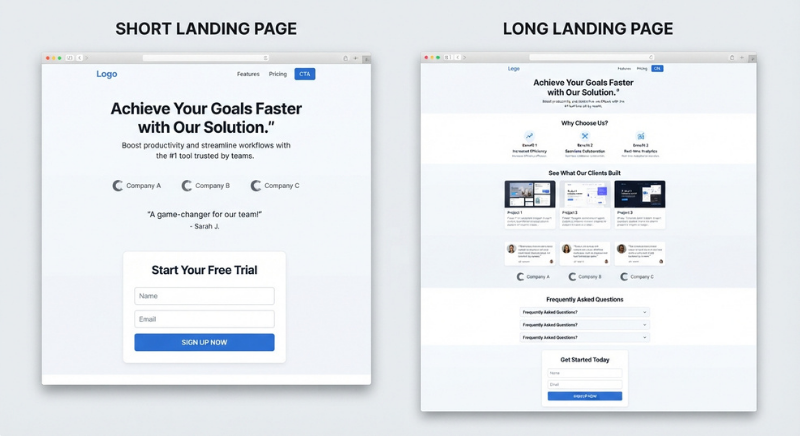
The goal isn’t simply to create a longer page. The goal is to test which version does a better job of turning the specific traffic you’re sending to the page into leads.
High value content offers for kitchen businesses
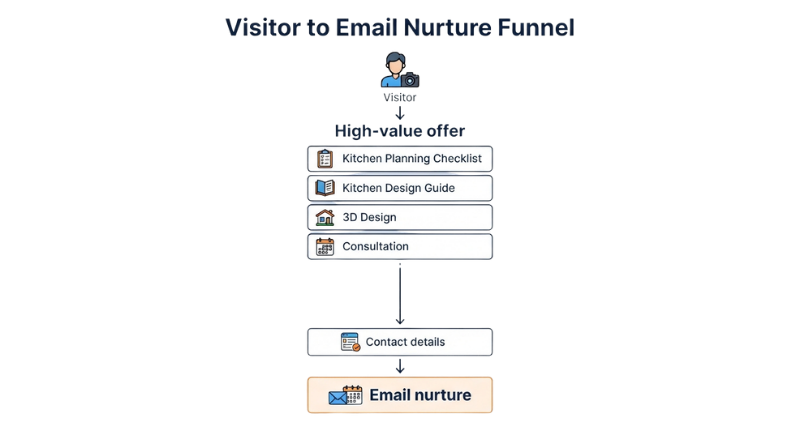
A high value content offer or a lead magnet is something valuable that you give away for free in exchange for your prospect’s contact details.. Ideally you want the offer to have SUPER HIGH perceived value but be really cheap for you to distribute.
To create a lead magnet I recommend making something that you’d feel like you had to charge money for. Good examples are:
- 3D Kitchen Design – Offer a free initial 3D kitchen concept or visualisation in exchange for contact details. This has particularly high perceived value because the prospect gets to see what their future kitchen could look like.
- Kitchen Design Consultation – Instead of giving away information, offer a free 30-minute consultation where a designer reviews the homeowner’s space and gives them initial recommendations.
- An after hours event – An event you host at your showroom, ideally you’ll also do a giveaway so people are more likely to come and give you their contact details.
- Kitchen Design Mistakes Guide – A guide covering the most common mistakes homeowners make when planning a new kitchen and how to avoid them.
- “Plan Your Dream Kitchen” Workbook – A printable workbook that walks homeowners through their needs, preferred style, layout, storage requirements, appliances and budget.
- Kitchen Planning Checklist – A step-by-step checklist covering everything a homeowner should decide before ordering a new kitchen, from layout and measurements to appliances, materials and storage.
Kitchen showroom marketing
Effective kitchen showroom marketing combines digital marketing with an immersive in-person experience. The best way that we have found to do this is by creating an afterhours event at your showroom and then marketing it on social media. The event can be a kitchen trends talk or a design your own kitchen workshop. This way you will get people who might be considering getting a kitchen to come to your showroom and have an awesome first experience with you. As you know, first impressions leave a mark.
To do this you first need to create an interesting event that will take place in your showroom after work hours or even on the weekend. Some good examples include:
- Kitchen Design Evening – Invite homeowners to an after-hours session where a kitchen designer walks them through the most important decisions when planning a new kitchen, from layout and storage to materials and appliances.
- Kitchen Inspiration Night – Host an evening where guests can explore your showroom, see different kitchen styles and materials in person, and get inspiration for their own project over drinks and snacks.
- Meet the Designer – Organize an informal evening with one of your kitchen designers where visitors can ask questions, discuss their ideas, and learn how a professional approaches the design process.
- Kitchen & Wine Evening – Partner with a local wine shop or sommelier and host a relaxed tasting evening in your showroom, using your kitchens as the setting.
- The Kitchen Trends of 2026 – Host an exclusive presentation showing the latest kitchen design trends, materials, colours, appliances and storage solutions that will shape kitchens in the coming year.
Then you will market the event on social media. For that you will create both static and video ads that call out your ideal customer, for example couples in their 30s and 40s who are buying a new home or couples in their 50s who are renovating their home. You should also add scarcity and urgency. You can create scarcity by saying how many people your showroom can fit. To create urgency you should mention the deadline as you get closer to the event.
As a bonus you can have a giveaway for all the people who show up and leave you their contact details.
Lead nurture for kitchen builders
Lead nurture means keeping in contact with your prospects until they buy. Most businesses give up on leads too quickly, even though today’s customers often interact with a business across multiple touchpoints before making a purchase. Research from Infillion found that consumers engage with an average of 11 touchpoints before purchasing. This is especially true for more expensive products like kitchens, that have a longer buying cycle. An effective lead nurturing system should not be trying to close your customer at each contact. Most times you should just be providing useful information. That way you don’t come off as pushy and instead they will think of you as an expert.
How to set up a lead nurture sequence?
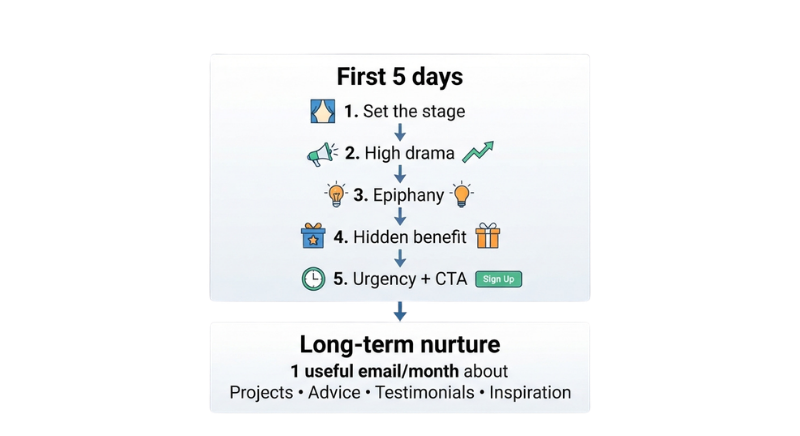
To set up an effective lead nurture sequence you should write 17 emails, which give your prospects useful information about kitchens. The first five will be sent out in 5 days after a prospect has given you their contact details. In this part you want to keep it problem centric. For example, if they gave you their details for a checklist, your first five should be about why it’s so important to use it. The storyline consists of 5 parts: setting the stage, opening with high drama, an epiphany, a hidden benefit and urgency. By starting off the sequence like this you ensure that more people will read your next emails.
The first five emails should go like this:
- Email 1 – set the stage
Send a thank you note, with the lead magnet they were promised. Then open up a loop (give them a reason to read your next email).
- Email 2 – open with high drama
You should start the story at the point of high drama (the middle), then go to the start of the story and end where the readers are at the moment. Usually that’s where you or a client (whose story you are sharing) hit a wall and then found the answer. Open a loop promising the answer in the next email.
- Email 3 – epiphany
You realise something that you hadn’t realised before. That’s when everything turns around. It should lead back to the core offer. As always, open up another loop to the next email.
- Email 4- hidden benefit
Point out benefits the reader is getting by using your product. Focus on what isn’t as obvious. Tell a story that reveals hidden benefits and then open up a loop to the last email.
- Email 5 – urgency and CTA
One last push to get them to take action right away. You can talk about your limited supply or how many clients you can work with each month.
After this sequence is done you add them to the next one, where you send at least one useful email per month to them for the next year. In those you can share useful information, show before & after photos and share client testimonials. The purpose of this part is to build up trust and to keep you in the minds of the prospects.
A bonus benefit of this is that you are building out one of the most valuable assets a business can have: an email list.
Kitchen marketing ideas checklist
Here is a 6 step kitchen marketing plan so you can easily set up everything you need for effectively marketing your kitchens online.
- Phase 1: Local Domination – Claim your Google Business Profile, upload 20+ recent kitchen portfolio photos, and target local high-intent keywords.
- Phase 2: AI & Future-Proofing (AEO) – Structure your FAQs with clear, conversational questions and direct answers that voice assistants and AI search engines can easily scrape.
- Phase 3: Content & Social – Publish short-form video walk-throughs (Reels/TikTok) for wide reach, and deep-dive case studies/material breakdowns for serious buyers.
- Phase 4: Paid Acquisition – Launch hyper-targeted Meta ad campaigns featuring your best-performing kitchen renders, backed by high-intent Google Search ads and send them to dedicated landing pages with high value content offers.
- Phase 5: Showroom Events – Host quarterly design or cooking masterclasses in your showroom to capture warm local foot traffic.
- Phase 6: Automated Nurturing – Set up a multi-touch CRM workflow that responds to inquiries within 5 minutes and follows up for at least a year.
Conclusion
The kitchen companies that win aren’t necessarily the ones that post the most or spend the most on ads. They’re the ones that build a system that consistently attracts the right people, captures their information, follows up with them and turns them into projects.
I know it was a lot of information so I do recommend you save this article for easy access later on. I want to leave you with an important reminder, that everything seems overwhelming the first time you try it. The important thing is just to start. So go film a video today. Or create your business profile on Google. Just start!
If you need help with any part of this system, you can contact me here: https://leadrescuer.kitchen/contact/
Frequently Asked Questions
What is kitchen marketing?
Kitchen marketing is the process of attracting people who are planning a new kitchen or kitchen renovation, turning them into leads and nurturing them until they are ready to buy. Effective kitchen marketing combines channels such as SEO, AEO, social media, paid advertising, landing pages, lead magnets, showroom marketing and lead nurture.
What is the best marketing strategy for a kitchen business?
The best kitchen marketing strategy combines multiple channels rather than relying on one source of leads. SEO and AEO help you attract people searching for kitchen-related information, social media helps you reach new audiences, paid advertising captures existing demand, and lead nurture keeps your business in front of prospects until they are ready to buy.
How can I get more leads for my kitchen business?
You can generate more kitchen leads by combining organic search, social media, Google and Meta ads, lead magnets, landing pages and showroom events. The key is to give potential customers a valuable reason to provide their contact details and then follow up with useful information until they are ready to start their kitchen project.
How can social media help a kitchen business?
Social media helps kitchen businesses reach people who may not yet be actively searching for a kitchen. Educational videos, project walkthroughs, design advice and interesting kitchen-related content can build an audience and establish the business as an expert. More product-focused content can then help turn interested followers into potential customers.
Are Google Ads effective for kitchen companies?
Google Ads can be effective for kitchen companies because they allow businesses to reach people who are actively searching for kitchen products and services. The most effective campaigns focus on high-intent, local searches and send visitors to dedicated landing pages rather than a generic homepage.
What is a good lead magnet for a kitchen business?
Good kitchen business lead magnets include a kitchen planning checklist, kitchen design mistakes guide, kitchen inspiration catalogue, kitchen budget planner, dream kitchen workbook or free design consultation. The best lead magnets solve a specific problem for homeowners and have high perceived value while being inexpensive for the business to distribute.
Why do kitchen businesses need lead nurture?
Kitchen businesses need lead nurturing because buying a kitchen is a significant decision and many prospects are not ready to buy when they first discover a company. A lead nurture system keeps the business in contact with prospects by sending useful information, completed projects and testimonials until they are ready to take the next step.
How can a kitchen showroom attract more customers?
A kitchen showroom can attract more customers by hosting events such as kitchen design evenings, inspiration nights, designer Q&As or kitchen trends presentations. These events can be promoted through social media and paid advertising and give potential customers a reason to visit the showroom and interact with the business in person.